
Amendment of the Constitution of India
Meaning of Amendment
- It is a formal change in the Constitution through addition, variation or repeal of its provisions.
- Article 368: Part XX gives Parliament the power and procedure to amend the Constitution.
- Flexible and Rigid: The Constitution combines flexible and rigid methods of amendment.
- Purpose: Amendments help the Constitution adapt to changing social, political and economic needs.
- 24th Amendment, 1971: Clarified Parliament’s power to amend any part of the Constitution, including Fundamental Rights, and made Presidential assent mandatory.
- First Amendment: The first Constitutional Amendment was enacted in 1951.
- Latest Amendment: The 106th Amendment Act, 2023 introduced provisions for women’s reservation in legislatures.
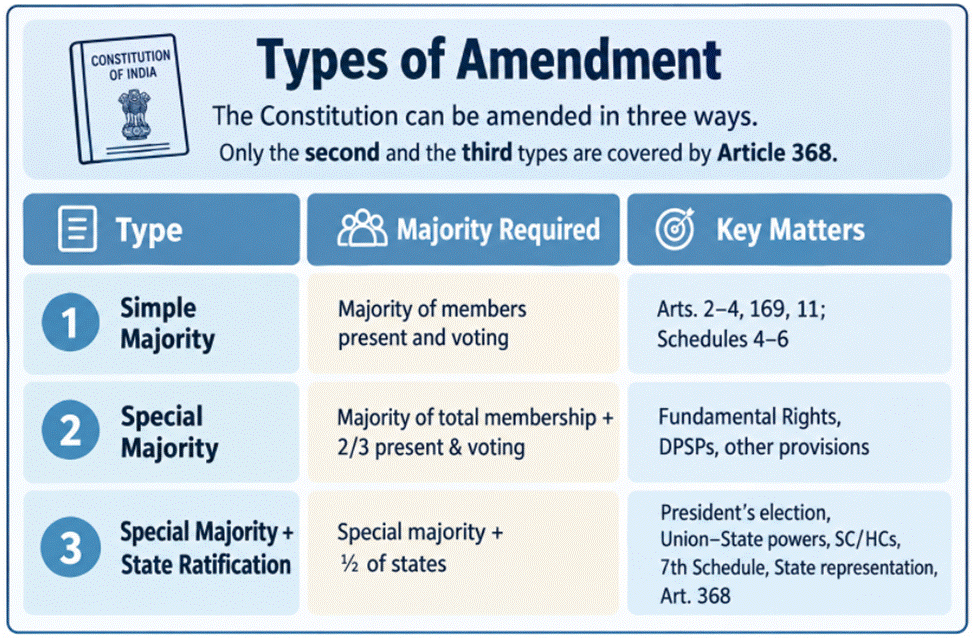
Procedure of Amendment under Article 368
- Introduction: Amendment Bill can be introduced in either House by a Minister or private member; no prior President’s permission is needed.
- Parliamentary Approval: Passed separately by both Houses with the required majority; no joint sitting.
- State Ratification: For federal provisions, at least half of the states must ratify the Bill.
- President’s Assent: The President must give assent and cannot return or withhold the Bill.
- Amendment: After assent, the Bill becomes an Act, amending the Constitution.
Amendment Procedure Borrowed From
| Source | Feature taken |
| Constitution of South Africa | The procedure for amendment of the Constitution (Article 368) Election of the members of the Rajya Sabha |
- The Constituent Assembly adopted a middle path in the amendment procedure so that the Constitution would be neither as rigid as that of the United States nor as flexible as that of the United Kingdom.
- The system of ratification by the states for the amendments affecting federal provisions follows the federal character of the Indian Union.
Important Amendments at a Glance
| Amendment | Year | Subject |
| 1st | 1951 | Ninth Schedule added. New restrictions on freedom of speech and expression. Special provisions for backward classes (Article 15(4)). |
| 7th | 1956 | Reorganisation of states on linguistic basis. Classification of states into Parts A, B, C and D abolished. Union Territories created. |
| 24th | 1971 | Parliament given power to amend Fundamental Rights. Assent of the President made compulsory. |
| 42nd | 1976 | Called the “Mini Constitution”. Changes in the Preamble. Fundamental Duties added. |
| 44th | 1978 | Right to property removed from Fundamental Rights. Safeguards against misuse of Emergency. |
| 52nd | 1985 | Tenth Schedule added. Disqualification of members on the ground of defection. |
| 61st | 1988 | Voting age reduced from 21 years to 18 years. |
| 73rd | 1992 | Constitutional status to Panchayati Raj institutions (Part IX, Eleventh Schedule). |
| 74th | 1992 | Constitutional status to urban local bodies (Part IXA, Twelfth Schedule). |
| 86th | 2002 | Right to Education made a Fundamental Right (Article 21A). |
| 91st | 2003 | Size of the Council of Ministers limited to 15 per cent of the strength of the House. Stricter anti-defection provisions. |
| 97th | 2011 | Constitutional status to co-operative societies (Part IXB). |
| 99th | 2014 | National Judicial Appointments Commission established. Struck down by the Supreme Court in 2015. |
| 100th | 2015 | Land boundary agreement with Bangladesh. Exchange of enclaves. |
| 101st | 2016 | Goods and Services Tax. |
| 102nd | 2018 | Constitutional status to the National Commission for Backward Classes. |
| 103rd | 2019 | Ten per cent reservation for Economically Weaker Sections. |
| 104th | 2019 | Reservation of seats for Scheduled Castes and Scheduled Tribes extended to 2030. Nomination of Anglo-Indians discontinued. |
| 105th | 2021 | Power of states to prepare their own list of Other Backward Classes restored. |
| 106th | 2023 | One-third reservation of seats for women in the Lok Sabha and State Legislative Assemblies. |
PYQs
1. Which Article of the Indian Constitution provides the Parliament the power to amend the Constitution? [Miscellaneous 2018]
(A) Article 360
(B) Article 368
(C) Article 390
(D) Article 356
Answer: (B) Article 368
2. Under which Prime Minister, and in which year, was the voting age in the Indian Constitution amended by reducing it from 21 to 18 years? [Miscellaneous 2019]
(A) Indira Gandhi, 1981
(B) Rajiv Gandhi, 1989
(C) P. V. Narasimha Rao, 1992
(D) Morarji Desai, 1978
Answer: (B) Rajiv Gandhi, 1989
3. The concepts ‘Secular’ and ‘Socialist’ were incorporated into the Preamble of the Constitution of India by which amendment? [Miscellaneous 2019]
(A) 44th Amendment
(B) 42nd Amendment, 1976
(C) 1st Amendment
(D) 52nd Amendment
Answer: (B) 42nd Amendment, 1976
4. Which right below no longer falls under the Fundamental Rights in the Indian Constitution following a constitutional amendment? [Miscellaneous 2012]
(A) Right to Education
(B) Right to Religious Freedom
(C) Right to Property
(D) Right to Equality
Answer: (C) Right to Property
5. By which amendment was the 9th Schedule introduced into the Constitution of India?
[Miscellaneous 2014]
(A) 1st Amendment, 1951
(B) 3rd Amendment, 1954
(C) 10th Amendment, 1961
(D) 14th Amendment, 1962
Answer: (A) 1st Amendment, 1951