
Amendment of the Constitution of India
Meaning of Amendment
- It is a formal change in the Constitution through addition, variation or repeal of its provisions.
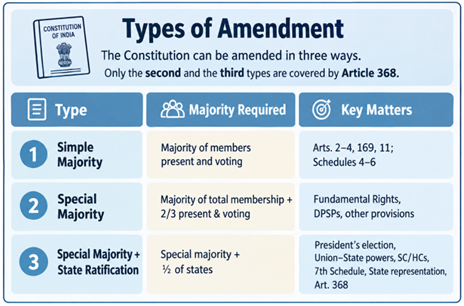
- Article 368 of Part XX gives Parliament the power and procedure to amend the Constitution through Special majority and Special majority with ratification of half of the state legislatures. (There are other provisions mentioned in the constitution that enables the Parliament to amend the Constitution by simple majority, though such provisions are not a part of Article 368.)
- Flexible and Rigid: The Constitution combines flexible and rigid methods of amendment.
- Purpose: Amendments help the Constitution adapt to changing social, political and economic needs.
- 24th Amendment, 1971: Clarified Parliament’s power to amend any part of the Constitution (without altering the Basic Structure of the constitution), including Fundamental Rights, and made Presidential assent mandatory.
- First Amendment: The first Constitutional Amendment was enacted in 1951.
- Latest Amendment: The 106th Amendment Act, 2023 introduced provisions for women’s reservation in legislatures.
Procedure of Amendment under Article 368
- Introduction: An amendment bill can be introduced in either House by a Minister or private member; no prior President’s permission is needed.
- Parliamentary Approval: Passed separately by both Houses with the required majority; no joint sitting.
- State Ratification: For federal provisions, at least half of the states must ratify the Bill.
- President’s Assent: The President must give assent and cannot return or withhold the Bill.
- Amendment: After assent, the Bill becomes an Act, amending the Constitution.
Amendment Procedure Borrowed From
| Source | Feature taken |
| Constitution of South Africa | The procedure for amendment of the Constitution (Article 368) Election of the members of the Rajya Sabha |
- The Constituent Assembly adopted a middle path in the amendment procedure so that the Constitution would be neither as rigid as that of the United States nor as flexible as that of the United Kingdom.
- The system of ratification by the states for the amendments affecting federal provisions follows the federal character of the Indian Union.
MOST IMPORTANT AMENDMENTS
| Amendment | Changes Introduced |
| 1st Amendment Act, 1951 | Addition of Ninth Schedule; Empowerment of the state for special provisions for the advancement of socially and economically backward classes; Insertion of 31A and 31 B |
| 2nd Amendment Act, 1952 | Readjustment of representation in Lok Sabha |
| 7th Amendment Act, 1956 | Abolition and reorganization of states into 14 states and 6 union territories; Extension of jurisdiction of high courts |
| 10th Amendment Act, 1961 | Incorporation of Dadra and Nagar Haveli in the Indian Union |
| 15th Amendment Act, 1963 | Enabled high courts to issue writs outside territorial jurisdiction; Increase in the retirement age of high court judges; appointment of retired judges; compensatory allowance to transferred judges |
| 24th Amendment Act, 1971 | Power of Parliament to amend any part of the Constitution |
| 25th Amendment Act, 1971 | Introduction of new Article 31C; limited the fundamental right to property |
| 26th Amendment Act, 1971 | Recognition granted to Rulers of Indian States to cease and privy purses to be abolished |
| 34th Amendment Act, 1974 | Amendment of the Ninth Schedule to include revised ceiling laws |
| 38th Amendment Act, 1975 | Emergency declared as non-justiciable; empowerment of the president to declare different proclamations of national emergency |
| 42nd Amendment Act, 1976 (Mini Constitution) | Addition of words socialist, secular and integrity in Preamble; Added Fundamental Duties; Extended tenure of Lok Sabha and state legislative assemblies; Established All-India Judicial Service |
| 44th Amendment Act, 1978 | Restoration of powers of the Supreme Court and high courts; made the right to property a legal right |
| 51st Amendment Act, 1984 | Provision of reservation of seats for Scheduled Tribes in certain states |
| 52nd Amendment Act, 1985 (Anti Defection Law) | Disqualification of members of Parliament and state legislatures on ground of defection |
| 61st Amendment Act, 1989 | Reduced voting age from 21 years to 18 years |
| 65th Amendment Act, 1990 | Establishment of National Commission for Scheduled Castes and Scheduled Tribes |
| 69th Amendment Act, 1991 | Made Delhi as ‘National Capital Territory of Delhi’ |
| 73rd Amendment Act, 1992 | Panchayati Raj Institutions included under Eleventh Schedule |
| 74th Amendment Act, 1992 | Gave constitutional status and protection to urban local bodies |
| 76th Amendment Act, 1994 | Included Tamil Nadu Reservation Act of 1994 in Ninth Schedule |
| 77th Amendment Act, 1995 | Provided for reservation in promotions in government jobs for SCs and STs |
| 80th Amendment Act, 2000 | An alternative scheme of devolution of revenue for sharing taxes |
| 85th Amendment Act, 2001 | Provided for “consequential seniority” in the case of promotion for SCs and STs |
| 86th Amendment Act, 2002 | Made elementary education a fundamental right |
| 91st Amendment Act, 2003 | Limited size of Council of Ministers; strengthened anti-defection law |
| 93rd Amendment Act, 2005 | Reservation for backward classes in private unaided educational institutions |
| 97th Amendment Act, 2012 | Gave constitutional status to co-operative societies |
| 99th Amendment Act, 2014 | Replaced collegium system of appointing judges with National Judicial Appointments Commission (NJAC) |
| 100th Amendment Act, 2015 | Gave effect to acquiring of territories by India and transfer of certain territories to Bangladesh |
| 101st Amendment Act, 2016 | Introduction of Goods and Service Tax |
| 102nd Amendment Act, 2018 | Provided constitutional status to the National Commission for Backward Classes |
| 103rd Amendment Act, 2019 | Empowered the state to make provisions for the advancement of any economically weaker sections (EWS) |
| 104th Amendment Act, 2020 | Extension of deadline for reserved seats for SCs and STs; Removal of reserved seats for Anglo-Indian community |
| 105th Amendment Act, 2021 | restores the power of State Governments and Union Territories to identify the Socially and Educationally Backward Classes (SEBCs). Amended Articles 338B, 342A, and 366 of the Constitution. |
| 106th Amendment Act, 2023 | Reserves one-third of all seats for women in Lok Sabha, State legislative assemblies, and the Legislative Assembly of the National Capital Territory of Delhi, including those reserved for SCs and STs. |
PREVIOUS YEAR QUESTION
1. The eighty-sixth Amendment of the Constitution of India altered a Directive Principle of the Constitution to provide for: [WBCS 2019]
(A) early childhood care and education for all children until they complete the age of six years.
(B) the state to provide free legal aid
(C) encouraging Village panchayats
(D) prohibiting intoxicating drinks and drugs injurious to health
Answer: (A) early childhood care and education for all children until they complete the age of six years.
2. Which of the following Amendments of the Indian Constitution is related to reservation of SC’s and ST’s and representation of Anglo Indians in the Lok Sabha and State Assembly?
[WBCS 2019]
(A) 54th Amendment
(B) 63rd Amendment
(C) 111th Amendment
(D) 79th Amendment
Answer: (D) 79th Amendment
3. Under which amendment of the Indian Constitution the voting age reduced to 18 from 21? [WBCS 2021]
(A) 60th
(B) 62nd
(C) 61st
(D) 63rd
Answer: (C) 61st
4. The 73rd Constitutional Amendment in 1992
- Provided a constitutional guarantee to the formation of Panchayats at the village and other levels
- Added a new part to the Constitution relating to urban local bodies
- Stipulated that all Panchayat member be elected for a five year term in elections supervised by State Election Commission
Which of the statements given above is/are correct? [WBCS 2010]
(A) 1 and 2
(B) 1 and 3
(C) 1 only
(D) 2 only
Answer: (B) 1 and 3
5. By which Amendment of the Indian Constitution were the fundamental duties of citizens inserted? [WBCS 2001]
(A) 40th Amendment
(B) 41st Amendment
(C) 42nd Amendment
(D) 43rd Amendment
Answer: (C) 42nd Amendment