
CELL CYCLE AND CELL DIVISION
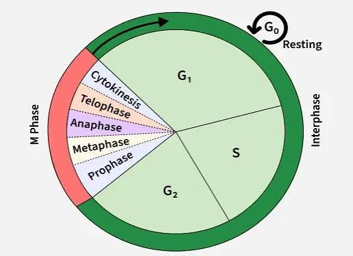
The cell cycle is the ordered sequence of events in which a eukaryotic cell grows, replicates its genome, and divides into two daughter cells. A standard human cell cycle takes about 24 hours to complete.
Phases of the Cell Cycle
The cell cycle is divided into two main parts: Interphase and the M Phase.
Interphase (The Preparation Phase):
Interphase takes up about 95% of the total time of the cell cycle. It is split into three steps:
- G1 Phase (Gap 1): The cell grows, remains metabolically active, and synthesizes RNA and proteins.
Cells that stop dividing may enter an inactive resting state called G0.
- S- Phase (Synthesis): DNA replication occurs. The amount of DNA doubles (from 2N to 4N)), though the chromosome number stays the same. Centrioles also duplicate in animal cells.
- G2 Phase (Gap 2): Cell growth continues, proteins are synthesized, and the cell makes final preparations for division.
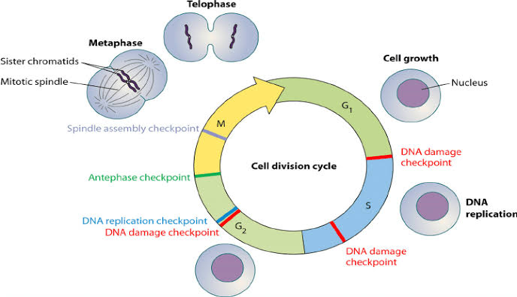
M Phase (Mitotic Phase):
This is the active division phase, lasting about an hour in human cells. It consists of:
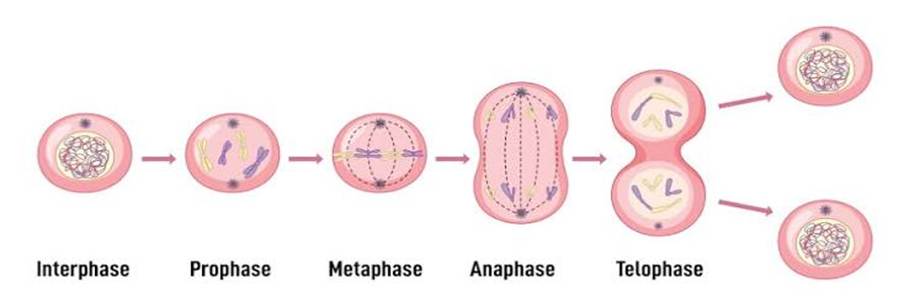
- Mitosis (Karyokinesis): Division of the nucleus, broken down into:
- Prophase: Chromosomes condense and the mitotic spindle starts to form.
- Metaphase: Chromosomes align at the middle (equatorial plate) of the cell.
- Anaphase: Sister chromatids separate and move to opposite poles.
- Telophase: Nuclear envelopes reform around the two new sets of chromosomes.
- Cytokinesis: Division of the cytoplasm, forming two distinct, genetically identical daughter cells.
Types of Cell Division
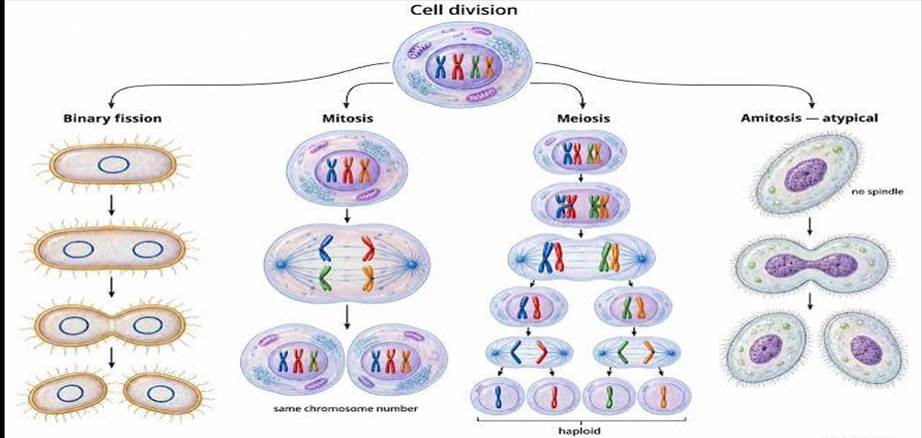
- Mitosis (Equational Division): Occurs in somatic cells. It maintains the exact same chromosome number in the daughter cells as in the parent cell. Used for growth and tissue repair.
- Meiosis (Reductional Division): Occurs in germ cells to produce haploid gametes (sperm and egg). It halves the chromosome number through two sequential divisions (Meiosis I and Meiosis II) and introduces genetic variation via crossing over.
- Amitosis (Direct Division): A simple, direct splitting of the nucleus and cytoplasm without distinct spindle or chromosome phases, seen mostly in lower unicellular organisms
Practice Questions:
1. Which phase of the cell cycle is known as the resting phase, during which the cell prepares for division?
(A) Mitotic phase
(B) Interphase
(C) Cytokinesis
(D) Anaphase
Answer: (B) Interphase (It accounts for more than 95% of the cell cycle duration, during which the cell grows and duplicates its DNA).
2. Which cell division is responsible for growth, repair, and asexual reproduction in multicellular organisms?
(A) Meiosis
(B) Mitosis
(C) Binary fission only
(D) Amitosis
Answer: (B) Mitosis (It is an equational division that produces two identical daughter cells with the same chromosome number).
3. During which phase of mitosis do chromosomes line up at the equatorial plane (metaphase plate) of the cell?
(A) Prophase
(B) Metaphase
(C) Anaphase
(D) Telophase
Answer: (B) Metaphase (Chromosomes reach their condensation peak and align precisely at the center).
4. Crossing over—the exchange of genetic material between non-sister chromatids of homologous chromosomes—occurs during which stage of meiosis?
(A) Leptotene
(B) Pachytene
(C) Diakinesis
(D) Zygotene
Answer: (B) Pachytene (It occurs during Prophase I of Meiosis I, creating genetic recombination and variation).
5. Which of the following is called “reductional division” because the chromosome number is halved in the daughter cells?
(A) Mitosis
(B) Meiosis I
(C) Meiosis II
(D) Amitosis
Answer: (B) Meiosis I (Homologous chromosomes separate, reducing diploid number to haploid).
6. The division of cytoplasm at the end of cell division is known as:
(A) Karyokinesis
(B) Cytokinesis
(C) Diakinesis
(D) Synapsis
Answer: (B) Cytokinesis (Karyokinesis is the division of the nucleus, while cytokinesis divides the cytoplasm).
7. During which sub-stage of Prophase I do homologous chromosomes pair up, a process known as synapsis?
(A) Leptotene
(B) Zygotene
(C) Pachytene
(D) Diplotene
Answer: (B) Zygotene (Paired homologous chromosomes form structures called bivalents).
8. At which stage of the cell cycle does DNA replication take place?
(A) G1 phase
(B) S phase (Synthesis phase)
(C) G2 phase
(D) M phase
Answer: (B) S phase (The amount of DNA per cell doubles, though the chromosome number remains unchanged).
9. During which phase of mitosis do sister chromatids (now individual chromosomes) pull apart and move toward opposite poles?
(A) Prophase
(B) Metaphase
(C) Anaphase
(D) Telophase
Answer: (C) Anaphase (Centromeres split, pulling chromatids apart toward opposite spindle poles).
10. Which phase marks the final stage of karyokinesis, where nuclear membranes reform around the two sets of chromosomes and chromosomes uncoil?
(A) Prophase
(B) Anaphase
(C) Telophase
(D) Metaphase
Answer: (C) Telophase (It is essentially the reverse of prophase).
11. Cells that do not divide further exit the G1 phase to enter an inactive stage called:
(A) S phase
(B) G0 phase (Quiescent stage)
(C) M phase
(D) Interkinesis
Answer: (B) G0 phase (Quiescent stage) (Cells remain metabolically active here without proliferating, e.g., heart cells).
12. Which type of cell division produces gametes (sperm and egg cells) in humans?
(A) Mitosis
(B) Meiosis
(C) Binary fission
(D) Budding
Answer: (B) Meiosis (Ensures constant chromosome number across generations through sexual reproduction).
13. The point on a chromosome where sister chromatids are held together and spindle fibers attach during cell division is called:
(A) Centrosome
(B) Centromere
(C) Centriole
(D) Chromomere
Answer: (B) Centromere (Serves as the attachment site for kinetochores and spindle fibers).
14. The X-shaped structure formed where crossing over has taken place between non-sister chromatids is called:
(A) Synaptonemal complex
(B) Chiasmata
(C) Spindle fiber
(D) Asters
Answer: (B) Chiasmata (Becomes visible during the Diplotene stage of Prophase I as homologous chromosomes begin to separate).
15. Meiosis II is structurally and functionally most similar to which of the following processes?
(A) Mitosis
(B) Meiosis I
(C) Binary Fission
(D) Amitosis
Answer: (A) Mitosis (Both involve the separation of sister chromatids, maintaining the same chromosome number in daughter cells).