
EARTH’S INTERIOR
Introduction
The Earth is not a solid, uniform ball. It is built in layers, like an onion, and each layer differs in composition, temperature, pressure and density. The surface we live on is only the outermost, thinnest skin of this structure.
No one has ever seen the deep interior. The deepest hole ever drilled is about 12 km, while the centre of the Earth lies about 6,371 km down. Scientists therefore rely mainly on seismic waves, along with temperature, pressure, gravity, magnetism and meteorites, to work out what lies below.
Important facts
| Fact | Value |
| Mean radius of Earth | about 6,371 km |
| Age of Earth | about 4.5 billion years |
| Average density of Earth | 5.5 g/cm³ |
| Deepest mine | Mponeng gold mine, South Africa (about 4 km) |
| Deepest drilling | Kola Superdeep Borehole, Russia (about 12 km, drilled by the Soviet Union in the 1970s–80s) |
Sources of Information About the Earth’s Interior
Humans cannot go deep inside the Earth, so scientists use two kinds of sources.
1. Direct Sources
These give actual samples of rock, but only from shallow depths.
- Mining: Deepest mines reach only about 3.9–4 km (Mponeng and TauTona, South Africa).
- Drilling: Kola Superdeep Borehole (Russia) is the deepest, about 12 km. Other projects include the Deep Ocean Drilling Project and the Integrated Ocean Drilling Program.
- Volcanic eruptions: Magma (molten rock below the surface) becomes lava on reaching the surface and can be studied in laboratories. However, the exact depth of its source is hard to determine.
2. Indirect Sources
These help us understand the full structure of the Earth.
- Increase of temperature, pressure and density with depth: Calculated using the Earth’s size and gravity.
- Seismic waves: The most important and reliable source for the layered structure.
- Meteorites: Formed from the same nebular material as the Earth. Iron-nickel meteorites resemble the core.
- Gravity anomalies: Differences in gravity from expected values show how mass is distributed in the crust.
- Magnetic surveys and the magnetic field: Reveal magnetic materials in the crust and the activity of the iron core.
Sources of Earth’s Heat
Temperature rises with depth. The main sources of internal heat are:
- Radioactive decay (uranium, thorium, potassium) in the crust and mantle: provides the largest share, more than half of Earth’s heat.
- Primordial heat: Left over from the formation of the Earth (impacts of meteorites and comets, friction from heavy iron sinking to the centre).
- Tidal friction: Gravitational pull of the Moon and Sun flexes the solid Earth, producing a small amount of heat. This also slows Earth’s rotation very slightly.
Temperature, Pressure and Density with Depth
| Property | Trend | Key values |
| Temperature | Increases with depth (rate is not uniform; about 15–30°C per km in the upper 100 km) | About 1,000°C at base of crust; about 3,500°C at base of mantle; about 5,000–6,000°C at the centre |
| Pressure | Increases due to the weight of overlying rocks | About 3–4 million times atmospheric pressure at the centre |
| Density | Increases because of pressure and heavier materials | Crust about 2.7–3.0 g/cm³; mantle about 3.3–5.5 g/cm³; core about 10–13 g/cm³ |
Even though the inner core is hotter than the melting point of iron, it stays solid because of the enormous pressure.
Layers Based on Chemical Composition
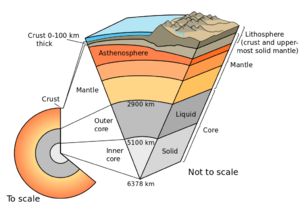
Based on composition, the Earth has three main layers: Crust, Mantle and Core.
The Crust
The crust is the outermost, thinnest and lightest layer. It makes up only about 1% of the Earth’s volume and mass, but almost all known life exists on it.
- Thickness: About 5 km to 70 km. It is thinnest under the oceans and thickest under major mountain ranges (such as the Himalayas).
- Composition: Igneous, sedimentary and metamorphic rocks. Igneous rocks (such as granite and basalt) are the most common.
- Most abundant elements (by weight): Oxygen (about 46.6%), Silicon (27.7%), Aluminium (8.1%), Iron (5%), Calcium, Sodium, Potassium, Magnesium. Memory trick: O-Si-Al-Fe-Ca-Na-K-Mg.
- Most abundant metal in the crust:
- Most abundant element in the crust:
The crust has two types:
| Feature | Oceanic Crust | Continental Crust |
| Also called | SiMa (Silica + Magnesium) | SiAl (Silica + Aluminium) |
| Main rock | Basalt (mafic and ultramafic) | Granite (felsic) |
| Rich in | Iron and magnesium | Silicon, aluminium and oxygen |
| Thickness | About 5–10 km | About 30–40 km (up to 70 km under mountains) |
| Density | About 2.9 g/cm³ (denser) | About 2.7 g/cm³ (lighter) |
| Age | Younger (less than about 200 million years) | Older (up to about 4 billion years) |
| Position | Lies lower, under oceans | Floats higher on the mantle |
| Formation | From magma rising from the mantle and cooling at the ocean floor | From melting of rocks and accumulation of sediments |
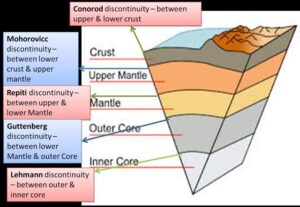
Crust–Mantle Boundary: Mohorovičić Discontinuity (Moho)
- Marks the base of the crust and the beginning of the mantle.
- Seismic wave velocity increases suddenly here because the mantle is denser.
- Discovered by the Croatian seismologist Andrija Mohorovičić in 1909.
- Depth: about 5–10 km under oceans and about 30–40 km (up to 70 km) under continents.
The Mantle
The mantle lies between the crust and the core. It is the largest layer.
- Thickness: About 2,900 km (from the Moho to the core).
- Share: About 84% of the Earth’s volume and about 67% of its mass.
- Density: About 3.3–5.5 g/cm³ (roughly 3.9 g/cm³ on average).
- Composition: Mostly silicate rocks rich in magnesium and iron. Common minerals are olivine, pyroxene and garnet. Peridotite is the major rock type.
- State: Mostly solid but able to flow very slowly over millions of years. Convection currents in the mantle drive plate movement.
- Source of magma: Magma that reaches the surface during volcanic eruptions originates in the upper mantle (the asthenosphere).
Divisions of the mantle
| Part | Depth | Notes |
| Upper mantle | Moho to about 660 km (includes the transition zone, about 410–660 km) | Contains the asthenosphere. The transition zone stores a large amount of water in its minerals. |
| Lower mantle | About 660 km to 2,900 km | Hotter, denser and more rigid. Its base has a thin region called D” (D-double-prime). |
- Repetti discontinuity: Boundary between the upper and lower mantle (about 660 km).
- Gutenberg discontinuity: Boundary between the mantle and the outer core (about 2,900 km).
The Core
The core is the hot, dense centre of the Earth.
- Radius: About 3,470 km (from 2,900 km depth to the centre at 6,371 km).
- Share: About 33% of the Earth’s mass but only about 16% of its volume.
- Composition: Mainly iron (Fe) and nickel (Ni), hence the name NiFe layer or Barysphere. Small amounts of sulphur, oxygen and silicon are also thought to be present.
- Density: About 10–13 g/cm³.
- Temperature: About 5,000–6,000°C, comparable to the surface of the Sun.
| Feature | Outer Core | Inner Core |
| Depth | About 2,900–5,150 km | About 5,150–6,371 km |
| Thickness | About 2,200 km | About 1,220 km |
| State | Liquid (molten iron and nickel) | Solid (due to immense pressure) |
| Special role | Generates Earth’s magnetic field through the geodynamo (convection of liquid metal) | Slowly grows as the Earth cools; rotates slightly faster than the surface |
- Lehmann discontinuity (also called the Bullen discontinuity in some books): Boundary between the outer core and inner core (about 5,150 km).
- S-waves do not pass through the outer core, and P-waves slow down and bend there.
Layers Based on Mechanical (Physical) Properties
Based on how rocks behave (rigid or flowing), the Earth is divided into:
Lithosphere
- The solid, rigid outer shell: the crust plus the uppermost mantle.
- Average thickness: About 100 km. It can reach about 200–300 km under old continents and mountain belts, and is thinner (about 50–100 km) under oceans.
- It is broken into large pieces called lithospheric (tectonic) plates, which float and move over the asthenosphere.
- It is the coolest and most rigid part of the Earth.
Asthenosphere
- A hot, weak, ductile and semi-molten layer in the upper mantle, just below the lithosphere.
- Depth: From about 100 km to about 350 km (some books say up to 400 km).
- Called the Low Velocity Zone (LVZ) because seismic wave speeds decrease
- Main source of magma for volcanoes.
- Allows the plates above it to move, which is why it is central to plate tectonics.
Mesosphere (Lower Mantle)
- The strong, more rigid part of the mantle below the asthenosphere, down to about 2,900 km.
Outer Core and Inner Core
- Outer core: liquid. Inner core: solid (as described above).
PYQ
1. What is the purpose of the Earth’s magnetic field? SSC CHSL 03/08/2023 (2nd shift)
(a) To provide an energy source for life on Earth
(b) To control the Earth’s climate
(c) To shield the Earth from solar wind and cosmic radiation
(d) To cause the tides in the ocean
Ans: (c) To shield the Earth from solar wind and cosmic radiation
2. The mohororvicic (Moho) discontinuity separates ? SSC MTS 13/09/2023 (3rd Shift)
(a) Earth’s lithosphere and asthenosphere
(b) Earth’s atmosphere and hydrosphere
(c) Earth’s crust and the inner core
(d) Earth’s crust and the mantle
Ans: (d) Earth’s crust and the mantle.
4. What is the name of the process of gases being outpoured from the interior of the solid earth ? Matriculation Level 26/06/2024 (Shift – 1)
(a) Evaporation
(b) Transpiration
(c) Degassing
(d) Gas evolution
Ans: (c) Degassing
5. How thick is the lithosphere? SSC CGL 03/12/2022 (1st Shift)
(a) 25 to 45 km
(b) 10 to 25 km
(c) 10 to 200 km
(d) 5 to 10 km
Ans: (c) 10 to 200 km.