
ECOLOGY & ECOSYSTEMS
Ecology
Ecology is the scientific study of how living organisms interact with each other and with their physical (non-living) environment. The term was coined by Ernst Haeckel (1866). Eugene Odum was known as ‘Father of Modern Ecology’. Ramdeo Misra was known as ‘Father of Indian Ecology’.
- Levels (small to big): Organism → Population (same species) → Community (all species together) → Ecosystem → Biome → Biosphere (whole Earth, the largest ecosystem).
Ecosystem and its Components
An ecosystem is the living (biotic) and non-living (abiotic) parts of an area interacting with each other. The term was coined by A.G. Tansley (1935). It is the basic functional unit of ecology.
Basic functional unit of ecology
| Component | Details |
| Abiotic | Sunlight, water, air, soil, temperature, humidity, minerals. |
| Producers | Autotrophs; make food by photosynthesis (green plants, algae). Base of every food chain. |
| Consumers | Heterotrophs. Herbivores (primary), small carnivores (secondary), top carnivores (tertiary), omnivores (human, crow). Scavengers eat dead bodies (vulture). |
| Decomposers | Bacteria and fungi; break dead matter into nutrients and return them to soil. |
- Types: Terrestrial (forest, desert, grassland), Aquatic (freshwater: pond, lake, river; marine: sea, coral reef, estuary) and Artificial (crop field, garden, aquarium).
- Sundarbans (West Bengal): world’s largest mangrove forest, UNESCO site, home of the Royal Bengal Tiger; mangroves have breathing roots (pneumatophores). East Kolkata Wetlands: Ramsar site.
Food Chain, Food Web, Trophic Levels
- Food chain: one-way sequence of who eats whom (Grass → Grasshopper → Frog → Snake). Usually only 3–5 steps.
- Types: Grazing (starts with plants), Detritus (starts with dead matter) and Parasitic.
- Trophic level: each step of a chain. T1 producer, T2 herbivore, T3 small carnivore, T4 top carnivore.
- Food web: many food chains interlinked; more stable than a single chain.
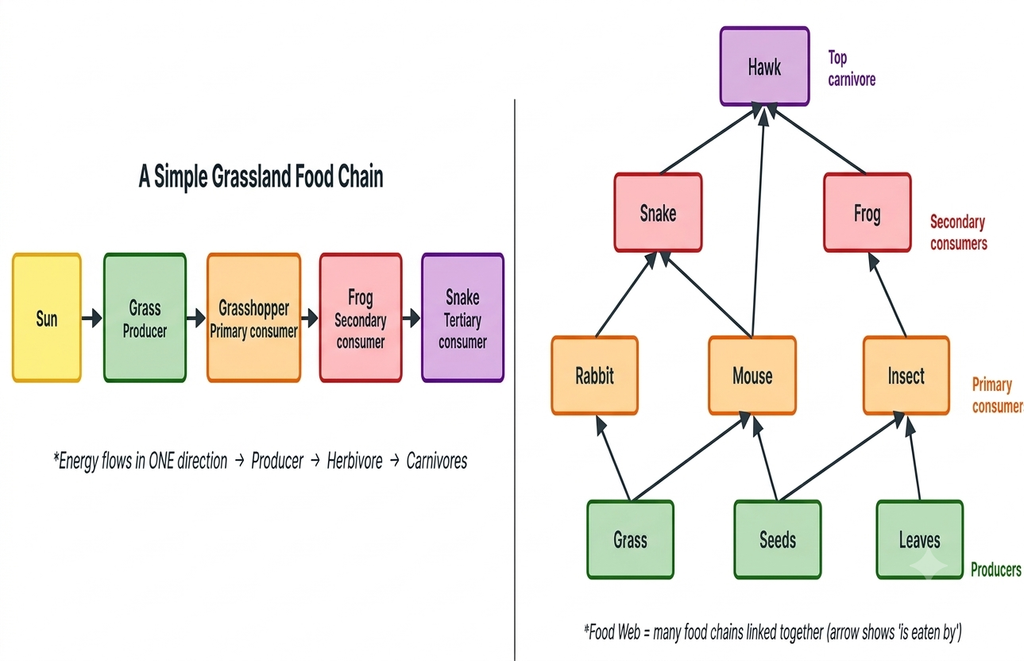
| Food chain | Food web |
Energy Flow and Ecological Pyramids
- Sun is the ultimate source of energy. Energy flows one way only (Sun → producers → consumers → decomposers) and is not recycled.
- Lindeman’s 10% law: only ~10% of energy passes to the next trophic level; ~90% is lost as heat. That is why chains are short.
- Pyramids: numbers (usually upright, can be inverted), biomass (can be inverted in a pond), energy (always upright).
- Biomagnification: harmful chemicals (e.g. DDT) get more concentrated at higher trophic levels; top carnivores suffer most.
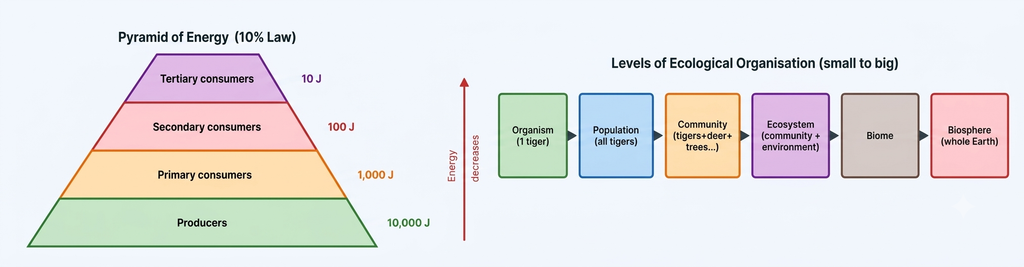
| Pyramid of energy (10% law) | Levels of organisation |
Nutrient Cycles
Energy flows, but nutrients are recycled (biogeochemical cycles).
- Water: evaporation → condensation → rain → runoff; plants add vapour by transpiration.
- Carbon: CO₂ taken in by photosynthesis; released by respiration, decay and burning of fuels.
- Nitrogen: air is 78% N₂ but plants need nitrates; Rhizobium (in pulse roots) fixes nitrogen.
Habitat, Niche and Interactions
Habitat: A habitat is the natural home or environment where a plant, animal, or other organism lives, grows, and reproduces. It provides all the essential conditions an organism needs to survive.
Niche: An ecological niche is the unique functional role, position, and way of life that a species has in its ecosystem.
Interaction: An interaction is the effect that organisms living in the same habitat have on one another, whether beneficial, harmful, or neutral.
Different types of interactions are:
- Mutualism (+/+): A relationship between two species in which both organisms benefit from the association.
Examples: Lichen (an alga provides food by photosynthesis, while the fungus provides shelter and absorbs water and minerals); bees and flowers (bees get nectar, flowers get pollinated).
- Commensalism (+/0): A relationship in which one species benefits while the other is neither helped nor harmed.
Example: An orchid growing on a tree (the orchid gets support and access to sunlight, while the tree is unaffected).
- Parasitism (+/−): A relationship in which one organism (the parasite) lives on or inside another (the host), obtaining nutrients from it and causing it harm.
Examples: A tapeworm in the intestine of a human or animal; Cuscuta (dodder), a plant that has no roots or chlorophyll of its own and draws nutrients from its host plant.
- Predation (+/−): A relationship in which one organism (the predator) hunts, kills, and eats another organism (the prey).
Example: A tiger hunting and eating a deer.
- Competition (−/−): A relationship in which two or more organisms contend for the same limited resources, such as food, space, light, or mates, so that both are negatively affected.
Example: Two plants in the same area competing for sunlight and soil nutrients, or lions and hyenas competing for the same prey.
- Adaptation: feature helping survival: camel (hump, padded feet), cactus (spines, thick stem), polar bear (fur, blubber), fish (gills, fins).
Ecological Succession
- Slow, orderly replacement of one community by another until a stable climax community forms.
- Pioneer species: first colonisers (lichens).
- Primary succession: starts on bare rock/new land.
- Secondary succession: starts where life existed before (after fire or flood); faster as soil is present.
- Bare rock sequence: Lichens → Mosses → Herbs → Shrubs → Trees (climax).
Human Impact and Conservation
- Problems: pollution, deforestation, global warming (CO₂, methane), ozone depletion (CFCs), loss of biodiversity.
- In-situ conservation: national parks, sanctuaries, biosphere reserves (WB: Sundarbans, Jaldapara, Gorumara, Buxa). Ex-situ: zoos, botanical gardens, seed banks.
- 3 Rs: Reduce, Reuse, Recycle.
- Sustainable development: meet today’s needs without harming future generations.
- Days: Environment Day 5 June; Earth Day 22 April; Wildlife Day 3 March; Wetlands Day 2 Feb.