
ENVIRONMENTAL POLLUTION
Pollution
Pollution is the addition of harmful substances (pollutants) to the environment, beyond its natural capacity to absorb or clean them.
Example: Smoke from a factory chimney, or sewage let into a river, adds more waste than the air or the river can clear by itself.
Pollutants: A pollutant is any substance, chemical, or energy form introduced into the environment that causes harmful or undesirable effects on nature, living organisms, or human health.
- Biodegradable (broken down by microbes: sewage, food waste, paper) and non-biodegradable (do not break down: plastic, DDT, glass, heavy metals).
- Primary pollutants are released directly (CO, SO₂).
- Secondary pollutants form from reactions in air (smog, ozone near ground, PAN).
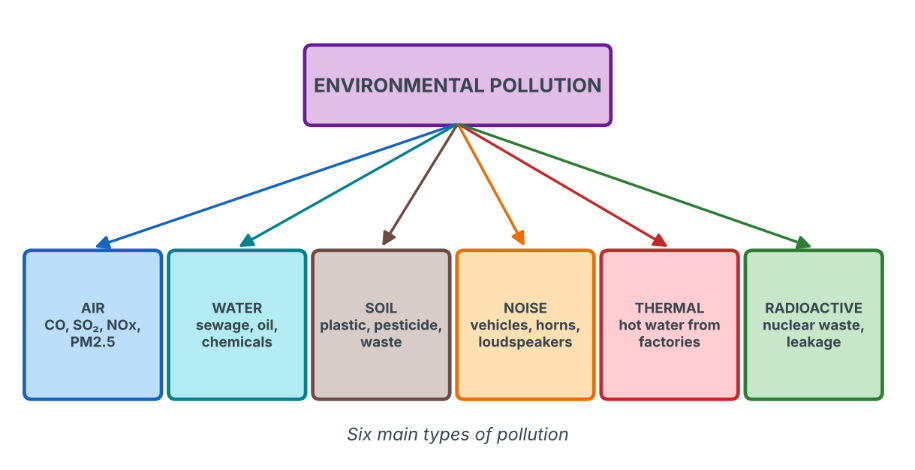
| Types of pollution |
Air Pollution
Air pollution is the presence in the air of gases, droplets or particles in amounts that harm living things or materials.
- Sources: vehicles, factories, thermal power plants, burning of coal/wood/crop residue, construction dust, forest fires.
- Main pollutants: CO (binds haemoglobin, reduces oxygen carrying; deadly in closed rooms), SO₂ and NOx (cause acid rain), SPM / PM2.5 / PM10 (tiny dust particles that enter lungs), lead, ozone, smoke.
- Effects: asthma, bronchitis, lung cancer, eye irritation; acid rain (pH below 5.6) harms plants, soil, buildings; smog (smoke + fog); damage to the Taj Mahal (‘stone cancer’).
- Measured by: Air Quality Index (AQI). Control: public transport, CNG/electric vehicles, cleaner fuels, filters and scrubbers, tree plantation, avoiding burning of waste.
Water Pollution
Water pollution is the contamination of rivers, ponds, lakes, groundwater and seas by substances that make the water unfit for its natural uses.
- Sources: domestic sewage, industrial effluents, agricultural runoff (fertilisers, pesticides), oil spills, dumping of garbage and idols, hot water.
- BOD (Biochemical Oxygen Demand): oxygen needed by microbes to break down waste; high BOD = highly polluted water. Dissolved oxygen (DO) falls, so fish die.
- Eutrophication: excess nitrates and phosphates make algae grow too fast (algal bloom); on decay they use up oxygen and aquatic life dies.
- Water-borne diseases: cholera, typhoid, dysentery, jaundice (hepatitis A). Chemical effects: fluorosis (excess fluoride), blue baby syndrome (nitrates), arsenicosis (arsenic).
- Control: sewage treatment plants, treating effluents before release, organic farming, Ganga Action Plan (1985) and Namami Gange (2014).
Soil, Noise, Thermal and Radioactive Pollution
| Type | Key points |
| Soil | Caused by plastics, pesticides, chemical fertilisers, industrial waste, mining. Effects: loss of fertility, harm to soil organisms, entry of toxins into food. Control: organic manure, reduce plastic, composting, proper waste disposal. |
| Noise | Unwanted loud sound; unit decibel (dB). Sources: traffic, horns, loudspeakers, crackers, machines. Above ~120 dB is painful, and long exposure causes hearing loss, stress, high blood pressure and lack of sleep. Control: silent zones, tree belts, limits on loudspeakers. |
| Thermal | Hot water from power plants and factories released in rivers; lowers oxygen and kills fish. |
| Radioactive | Nuclear accidents and waste (Chernobyl 1986, Fukushima 2011). Causes cancer and genetic damage. Safe, shielded storage of waste is needed. |
Global Environmental Issues
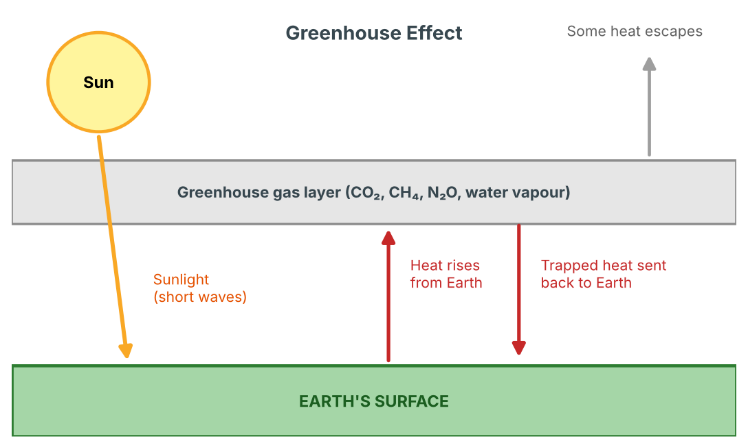
- Greenhouse effect: natural trapping of heat by gases keeps Earth warm. Global warming = extra warming from more greenhouse gases (CO₂, methane CH₄, N₂O, CFCs). Effects: melting ice, sea-level rise, floods, droughts, changing climate.
- Ozone depletion: ozone layer in the stratosphere absorbs harmful UV rays. CFCs from fridges, ACs and aerosols destroy it. Effects: skin cancer, cataract, crop damage. Ozone Day: 16 September.
- Acid rain: SO₂ and NOx dissolve in rain (pH below 5.6).
- Agreements: Montreal Protocol (1987) for CFCs; Kyoto Protocol (1997) for greenhouse gases; Paris Agreement (2015) to limit warming well below 2°C.
Solid Waste, E-waste and Plastics
- Solid waste management: segregate into wet (biodegradable) and dry waste, then use Reduce, Reuse, Recycle (3Rs), composting, landfill, incineration.
- E-waste: discarded phones, computers, batteries; contains lead and mercury, so it needs safe recycling.
- Plastic: non-biodegradable and harms animals and soil; use cloth or jute bags instead.
Laws, Institutions and Landmark Events
| Law / Body / Event | Key fact |
| Water Act | 1974 (prevention and control of water pollution) |
| Air Act | 1981 (prevention and control of air pollution) |
| Environment Protection Act | 1986 (umbrella law, passed after the Bhopal disaster) |
| CPCB / WBPCB | Central / West Bengal Pollution Control Board |
| National Green Tribunal (NGT) | Set up in 2010 for environmental cases |
| Bhopal Gas Tragedy | 1984; leak of methyl isocyanate (MIC) gas |
| Minamata disease | Japan; mercury poisoning of fish and people |
| Itai-itai disease | Japan; cadmium poisoning |
| Important days | Environment Day – 5 June Earth Day – 22 April Ozone Day – 16 Sept |