
Number System
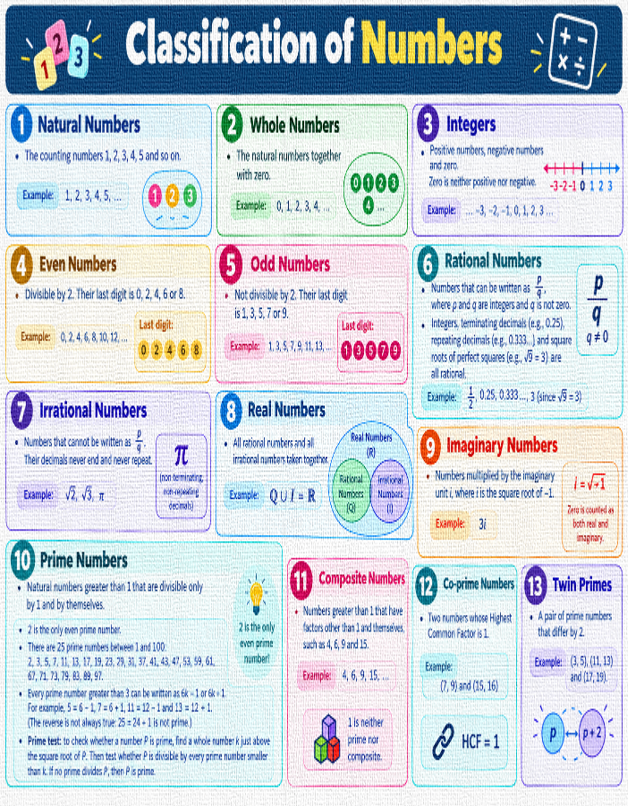
Solved example
Is 97 a prime number?
The square root of 97 lies between 9 and 10, so take k = 10. The primes smaller than 10 are 2, 3, 5 and 7. 97 is odd, so 2 does not divide it. Its digit sum is 9 + 7 = 16, so 3 does not divide it. It does not end in 0 or 5, so 5 does not divide it. 97 ÷ 7 leaves remainder 6, so 7 does not divide it. Therefore 97 is prime.
Divisibility Rules and Shortcuts
| Divisor | Test |
| 2 | The last digit is 0, 2, 4, 6 or 8. |
| 3 | The sum of the digits is divisible by 3. |
| 4 | The number formed by the last two digits is divisible by 4 (or the number ends in 00). |
| 5 | The last digit is 0 or 5. |
| 8 | The number formed by the last three digits is divisible by 8. |
| 9 | The sum of the digits is divisible by 9. |
| 10, 100, 1000 | The number ends in one zero, two zeros or three zeros respectively. |
| 11 | Find the sum of the digits at odd places and the sum of the digits at even places. If the difference is 0 or a multiple of 11, the number is divisible by 11. |
| 2n (any power of 2) | The last n digits form a number divisible by 2n. For example, for 16 = 24, check the last four digits. |
| 6 | The number is divisible by both 2 and 3. |
| 15 | The number is divisible by both 3 and 5. |
| 24 | The number is divisible by both 3 and 8. |
| 40 | The number is divisible by both 5 and 8. |
| 80 | The number is divisible by both 5 and 16. |
Remember: a shortcut such as “divisible by both 3 and 8 means divisible by 24” works only when the two numbers are co-prime (have no common factor other than 1).
Solved examples
1. Is 2,376 divisible by 8? Last three digits: 376. 376 ÷ 8 = 47 exactly. So the answer is yes.
2. Is 2,816 divisible by 11? Digits at odd places (first and third): 2 + 1 = 3. Digits at even places (second and fourth): 8 + 6 = 14. Difference = 14 − 3 = 11. So the answer is yes.
Finding the Unit Digit (Cyclicity)
When a number is raised to a high power, its unit digit repeats in a fixed cycle. Only the unit digit of the base number matters.
| Unit digit of base | Cycle length | Pattern | Rule |
| 0, 1, 5, 6 | 1 | Never changes | The unit digit stays the same: 0n ends in 0, 1n ends in 1, 5n ends in 5, 6n ends in 6. |
| 4, 9 | 2 | Alternates | 4 to an odd power ends in 4; 4 to an even power ends in 6. 9 to an odd power ends in 9; 9 to an even power ends in 1. |
| 2, 3, 7, 8 | 4 | Four-step cycle | Divide the power by 4 and find the remainder r. If r is not 0, the unit digit is the unit digit of Baser. If r = 0, use Base4. |
The four-step cycles are: 2, 4, 8, 6 | 3, 9, 7, 1 | 7, 9, 3, 1 | 8, 4, 2, 6.
Solved examples
1. Unit digit of 350: 50 ÷ 4 leaves remainder 2. So the unit digit is that of 32 = 9.
2. Unit digit of 844: 44 ÷ 4 leaves remainder 0. So use 84 = 4096, and the unit digit is 6.
Remainders (Advanced Ideas Made Easy)
- Division rule: Dividend = (Divisor × Quotient) + Remainder. Example: 29 = (6 × 4) + 5, so 29 ÷ 6 leaves remainder 5.
- Negative remainder: a negative remainder tells us how far the number is below the next multiple of the divisor. Actual positive remainder = Divisor + Negative remainder.
- Example: 13 = (7 × 2) − 1, so the remainder is −1. Actual remainder = 7 + (−1) = 6.
- Remainder of a sum: the remainder of (A + B) divided by N equals the remainder of (remainder of A + remainder of B) divided by N.
- Remainder of a product: the remainder of (A × B) divided by N equals the remainder of (remainder of A × remainder of B) divided by N.
- Example: 17 × 23 divided by 5. 17 leaves 2 and 23 leaves 3. Multiply 2 × 3 = 6. 6 divided by 5 leaves 1. So the answer is 1.
- Example using negative remainders: 14 × 13 divided by 15. 14 is 1 less than 15, so remainder −1. 13 is 2 less than 15, so remainder −2. Product = (−1) × (−2) = 2. The remainder is 2.
- Special forms:
- an + bn is always divisible by (a + b) when n is odd. Example: 23 + 33 = 35, which is divisible by 5.
- an − bn is always divisible by (a + b) when n is even. Example: 52 − 32 = 16, which is divisible by 8.
- an − bn is always divisible by (a − b) for every natural number n. Example: 53 − 23 = 117, which is divisible by 3.
- Fermat’s Little Theorem: if p is a prime number and a has no common factor with p other than 1, then ap−1 divided by p leaves remainder 1. Example: 512 divided by 13 leaves remainder 1, because 13 is prime and 12 = 13 − 1.
- Euler’s Totient Theorem: if a and N are co-prime, then a raised to the power T divided by N leaves remainder 1, where T is the count of numbers from 1 to N that are co-prime to N. Example: N = 10. The numbers co-prime to 10 are 1, 3, 7, 9, so T = 4. Hence 34 = 81 divided by 10 leaves remainder 1.
Indices and Surds
Laws of indices
- xm × xn = xm+n. Example: 32 × 34 = 36 = 729.
- xm ÷ xn = xm−n. Example: 27 ÷ 24 = 23 = 8.
- (xm)n = xmn. Example: (23)2 = 26 = 64.
- (xy)n = xn × yn. Example: (2 × 5)2 = 4 × 25 = 100.
- x−1 = 1 ÷ x. Example: 4−1 = 1 ÷ 4. Also, any non-zero number raised to the power 0 equals 1.
Laws of surds
- The nth root of x = x1/n. Example: the square root of 16 = 161/2 = 4.
- The nth root of (x × y) = (nth root of x) × (nth root of y). Example: √3 × √12 = √36 = 6.
- (The nth root of x) raised to the power n = x. Example: (√7)2 = 7.
- The mth root of the nth root of x = the (m × n)th root of x. Example: the square root of the square root of 81 = the fourth root of 81 = 3.
Sequences, Series and Standard Sums
Special sums
- Sum of the first n natural numbers = n × (n + 1) ÷ 2. Example: 1 + 2 + … + 10 = 10 × 11 ÷ 2 = 55.
- Sum of the squares of the first n natural numbers = n × (n + 1) × (2n + 1) ÷ 6. Example: for n = 5, the sum is 5 × 6 × 11 ÷ 6 = 55.
- Sum of the cubes of the first n natural numbers = [n × (n + 1) ÷ 2]2. Example: for n = 4, the sum is (4 × 5 ÷ 2)2 = 102 = 100.
- Sum of the first n odd numbers = n2. Example: 1 + 3 + 5 + 7 = 16 = 42.
- Sum of the first n even numbers = n × (n + 1). Example: 2 + 4 + 6 + 8 + 10 + 12 = 6 × 7 = 42.
Arithmetic Progression (a list in which the same number is added each time)
- Let a be the first term, d the common difference and n the number of terms.
- nth term = a + (n − 1) × d.
- Sum of n terms = n ÷ 2 × [2a + (n − 1) × d], which is also n ÷ 2 × (first term + last term).
- Example: 5, 8, 11, … Here a = 5 and d = 3. The 8th term = 5 + 7 × 3 = 26.
Geometric Progression (a list in which each term is multiplied by the same number)
- Let a be the first term, r the common ratio and n the number of terms.
- nth term = a × rn−1.
- Sum of n terms = a × (rn − 1) ÷ (r − 1) when r is greater than 1. When r is less than 1, use a × (1 − rn) ÷ (1 − r).
- Sum of infinitely many terms = a ÷ (1 − r), valid only when r lies between −1 and 1.
- Example: 8, 4, 2, 1, … Here a = 8 and r = 1/2. The infinite sum = 8 ÷ (1 − 1/2) = 16.
Arithmetic Mean and Geometric Mean
- For two positive numbers a and b, the Arithmetic Mean (a + b) ÷ 2 is always greater than or equal to the Geometric Mean √(a × b). Example: a = 4 and b = 9 give 6.5 and 6.
- For any positive number x, the smallest possible value of x + 1/x is 2 (it happens when x = 1).
Greatest Integer Function
The greatest integer function [x] gives the largest integer that does not exceed x. It is also called the floor function. Examples: [3.7] = 3, [5] = 5 and [−2.3] = −3.
Key properties
- [x] = x if and only if x is an integer.
- [x + n] = [x] + n for any real number x and any integer n. Example: [2.6+ 3] = [5.6] = 5 = 2 + 3.
- [x] + [−x] = 0 if x is an integer, and = −1 if x is not an integer. Example: [2.5] + [−2.5] = 2 + (−3) = −1.
Legendre’s Formula
The highest power of a prime number p that divides n! (n factorial, meaning 1 × 2 × 3 × … × n) is [n ÷ p] + [n ÷ p2] + [n ÷ p3] + … continued until the term becomes 0.
Example: highest power of 5 in 25!. [25 ÷ 5] + [25 ÷ 25] = 5 + 1 = 6.
Example: highest power of 2 in 10!. [10 ÷ 2] + [10 ÷ 4] + [10 ÷ 8] = 5 + 2 + 1 = 8.
Practice Sums
Try all fifteen sums on your own first. Then check the answer key and the solutions.
Sum 1. Write all the prime numbers between 20 and 40.
Sum 2. Is 97 a prime number? Use the prime test to decide.
Sum 3. Is 3,456 divisible by 24?
Sum 4. Is 7,293 divisible by 11?
Sum 5. Find the smallest digit that can replace the blank in 74_ so that the number is divisible by 3.
Sum 6. Find the unit digit of 727.
Sum 7. Find the unit digit of 435 + 920.
Sum 8. Find the remainder when 47 × 52 is divided by 5.
Sum 9. Find the remainder when 210 is divided by 11.
Sum 10. Simplify: 25 × 23 ÷ 26.
Sum 11. Find the value of √2 × √8.
Sum 12. Find the sum of the first 15 natural numbers.
Sum 13. In the Arithmetic Progression 3, 7, 11, 15, …, find the 10th term and the sum of the first 10 terms.
Sum 14. Find the sum of the first 5 terms of the Geometric Progression 3, 6, 12, 24, 48, …
Sum 15. Find the value of [6.8] + [−3.2], where [x] is the greatest integer function.
Answer Key
| Sum | Answer |
| 1 | 23, 29, 31 and 37 |
| 2 | Yes, 97 is prime |
| 3 | Yes |
| 4 | Yes |
| 5 | 1 |
| 6 | 3 |
| 7 | 5 |
| 8 | 4 |
| 9 | 1 |
| 10 | 4 |
| 11 | 4 |
| 12 | 120 |
| 13 | 10th term = 39; sum = 210 |
| 14 | 93 |
| 15 | 2 |
Solutions
Sum 1.Check each number from 21 to 39. The even numbers are not prime. Among the odd numbers, 21 = 3 × 7, 25 = 5 × 5, 27 = 3 × 9, 33 = 3 × 11, 35 = 5 × 7 and 39 = 3 × 13 are composite.
The numbers left are 23, 29, 31 and 37.
Answer: 23, 29, 31 and 37.
Sum 2.The square root of 97 lies between 9 and 10, so take k = 10. The primes smaller than 10 are 2, 3, 5 and 7.
97 is odd, so 2 does not divide it. Digit sum = 9 + 7 = 16, which is not divisible by 3. The last digit is 7, so 5 does not divide it. 97 ÷ 7 = 13 with remainder 6, so 7 does not divide it.
No prime smaller than 10 divides 97.
Answer: Yes, 97 is prime.
Sum 3.24 = 3 × 8, and 3 and 8 are co-prime, so test both.
Divisibility by 3: digit sum = 3 + 4 + 5 + 6 = 18, which is divisible by 3.
Divisibility by 8: last three digits = 456, and 456 ÷ 8 = 57 exactly.
The number is divisible by both 3 and 8.
Answer: Yes. (Check: 24 × 144 = 3,456.)
Sum 4.Digits of 7,293 are 7, 2, 9, 3.
Sum at odd places (first and third) = 7 + 9 = 16. Sum at even places (second and fourth) = 2 + 3 = 5.
Difference = 16 − 5 = 11, which is a multiple of 11.
Answer: Yes. (Check: 11 × 663 = 7,293.)
Sum 5.
The digits already present add up to 7 + 4 = 11.
Try the blank digit 0: 11 is not divisible by 3. Try 1: 11 + 1 = 12, which is divisible by 3.
Answer: 1. (The number is 741 = 3 × 247.)
Sum 6.The base ends in 7, so the cycle has length 4: 7, 9, 3, 1.
Divide the power by 4: 27 ÷ 4 = 6 with remainder 3.
The unit digit is that of 73 = 343, which is 3.
Answer: 3.
Sum 7.
For 435: the power 35 is odd, so the unit digit is 4.
For 920: the power 20 is even, so the unit digit is 1.
Add the unit digits: 4 + 1 = 5.
Answer: 5.
Sum 8.47 ÷ 5 leaves remainder 2. 52 ÷ 5 leaves remainder 2.
Multiply the remainders: 2 × 2 = 4. Since 4 is less than 5, it is the final remainder.
Answer: 4. (Check: 47 × 52 = 2,444 = 5 × 488 + 4.)
Sum 9.11 is a prime number and 2 has no common factor with 11 other than 1.By Fermat’s Little Theorem, 211−1 = 210 leaves remainder 1 when divided by 11.
Answer: 1. (Check: 210 = 1,024 = 11 × 93 + 1.)
Sum 10.All the bases are the same, so add the powers when multiplying and subtract the powers when dividing.
25 × 23 ÷ 26 = 25+3−6 = 22 = 4.
Answer: 4.
Sum 11.Use the law: √x × √y = √(x × y).
√2 × √8 = √(2 × 8) = √16 = 4.
Answer: 4.
Sum 12.Use the formula: sum of the first n natural numbers = n × (n + 1) ÷ 2.
Here n = 15, so the sum = 15 × 16 ÷ 2 = 240 ÷ 2 = 120.
Answer: 120.
Sum 13.First term a = 3, common difference d = 7 − 3 = 4, number of terms n = 10.
nth term = a + (n − 1) × d, so the 10th term = 3 + 9 × 4 = 3 + 36 = 39.
Sum = n ÷ 2 × (first term + last term) = 10 ÷ 2 × (3 + 39) = 5 × 42 = 210.
Answer: 10th term = 39; sum = 210.
Sum 14.First term a = 3, common ratio r = 6 ÷ 3 = 2, number of terms n = 5. Since r is greater than 1, use Sum = a × (rn − 1) ÷ (r − 1).
Sum = 3 × (25 − 1) ÷ (2 − 1) = 3 × 31 ÷ 1 = 93.
Answer: 93. (Check: 3 + 6 + 12 + 24 + 48 = 93.)
Sum 15.[6.8] is the largest integer not exceeding 6.8, which is 6.
[−3.2] is the largest integer not exceeding −3.2, which is −4 (because −4 is less than −3.2, while −3 is greater than −3.2).
Sum = 6 + (−4) = 2.
Answer: 2.