
Pedagogy of Language Development
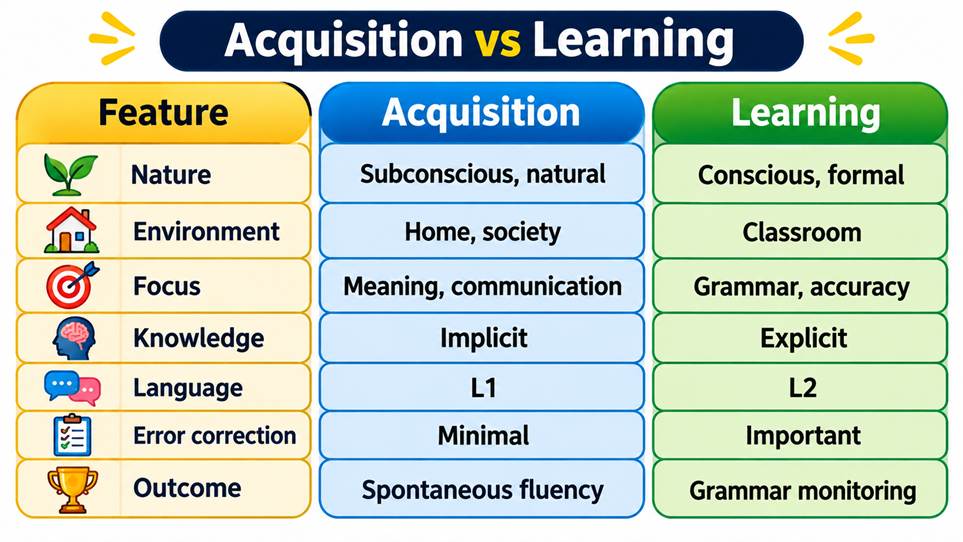
Pedagogy of Language Development: Acquisition vs Learning
Fundamental Concepts
Language Acquisition
- Natural, subconscious and informal process.
- Usually develops through exposure to meaningful communication.
- Generally associated with mother tongue / First Language (L1).
- No formal grammar instruction required.
Language Learning
- Conscious and formal process, usually in classrooms.
- Involves grammar rules, sentence structures and vocabulary.
- Develops explicit knowledge about language.
- Generally associated with Second / Foreign Language (L2).
Major Theories
Stephen Krashen – Acquisition-Learning Hypothesis
- Two systems: subconscious Acquisition and conscious Learning.
- Monitor Hypothesis: Learned grammar checks and corrects acquired speech.
- Input Hypothesis: Comprehensible Input (i+1), slightly above current level, promotes acquisition.
- Affective Filter: Anxiety and low confidence block acquisition.
Noam Chomsky – Nativist Theory
- Humans have an innate language-learning ability.
- LAD: Language Acquisition Device.
- UG: Universal Grammar, common structural principles of languages.
- Children create new grammatical sentences, proving language is not merely imitation.
B.F. Skinner – Behaviorist Theory
- Language develops through stimulus, response, imitation and reinforcement.
- Learning occurs through habit formation.
- Foundation of the Audio-lingual Method, using repetition and drills.
Lev Vygotsky – Social Interactionist Theory
- Language develops through social interaction and culture.
- ZPD: Difference between independent performance and performance with guidance.
- MKO: More Knowledgeable Other.
- Scaffolding: Guided support.
- Social speech → Private speech → Inner speech.
Important Pedagogical Points
- LSRW: Listening → Speaking → Reading → Writing.
- i+1: Meaningful input slightly above the learner’s level.
- Affective Filter: Reduce fear, anxiety and excessive correction.
- Silent Period: Beginners may listen and absorb before speaking. Do not force early speech.