
Plate Tectonics & Boundaries
1. Introduction
- Plate Tectonics is the theory that the lithosphere (the rigid outer layer of the Earth) is broken into large slabs called tectonic plates.
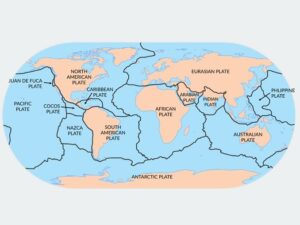
- These plates move very slowly (a few cm per year) over the asthenosphere, a semi-molten, ductile layer of the upper mantle.
- Plate movement is responsible for mountains, volcanoes, earthquakes, ocean trenches, mid-ocean ridges and the drifting of continents.
2. Evolution of the Theory
| Year | Scientist | Contribution |
| 1912 | Alfred Wegener (German) | Continental Drift Theory; supercontinent Pangaea |
| 1930s | Arthur Holmes | Mantle convection current hypothesis |
| 1960–62 | Harry Hess | Sea-floor spreading |
| 1963 | Vine & Matthews | Magnetic stripes (paleomagnetism) on ocean floor |
| 1967–68 | McKenzie & Parker, W. J. Morgan | Formal Plate Tectonics Theory |
Key points
- Wegener proposed Continental Drift (1912), not Plate Tectonics. Plate Tectonics (late 1960s) is the modern, comprehensive theory that grew out of it.
- Wegener’s supercontinent: Pangaea; the surrounding ocean: Panthalassa.
- Pangaea split into Laurasia (north) and Gondwanaland (south).
- Evidence: sea-floor spreading, paleomagnetism, matching fossils and rock formations across continents.
3. Significance of the Theory
Plate Tectonics is the most widely accepted explanation for large-scale Earth processes. It explains:
- Origin and breakup of continents and oceans
- Formation of fold mountains by collision of plates
- Earthquakes along fault lines and plate margins
- Volcanic eruptions at subduction zones and mid-ocean ridges
4. Types of Plates
| Type | Rock Composition | Nature |
| Continental plate | Granitic (SIAL: silica + aluminium) | Lighter, thicker |
| Oceanic plate | Basaltic (SIMA: silica + magnesium) | Denser, thinner |
| Mixed plate | Both continental and oceanic crust | – |
- A plate is classed as continental or oceanic according to the dominant crust it carries.
- Pacific Plate – almost entirely oceanic.
- Eurasian Plate – mostly continental (with some oceanic portion).
5. Major and Minor Plates
Seven Major Plates
- Pacific Plate (largest)
- Eurasian Plate
- North American Plate
- South American Plate
- African Plate
- Indo-Australian Plate
- Antarctic Plate
Important Minor Plates
| Plate | Location |
| Cocos | Between Central America and the Pacific Plate |
| Nazca | Between South America and the Pacific Plate |
| Arabian | Most of the Arabian Peninsula / Middle East |
| Philippine | Between the Asian and Pacific Plates |
| Caroline | North of New Guinea |
| Fiji | Northeast of Australia |
| Juan de Fuca | Off the northwest coast of North America |
| Scotia | Between South America and Antarctica |
| Caribbean | Caribbean Sea region |
6. Forces Driving Plate Movement
- Source of energy: heat from the Earth’s interior.
- Heat sources: radioactive decay of uranium, thorium and potassium, plus leftover heat from the Earth’s formation.
- Convection currents: hot mantle material rises, spreads, cools and sinks, creating circular flow in the asthenosphere that moves the plates above.
- Arthur Holmes (1930s) proposed mantle convection; this idea laid the foundation for Harry Hess’s sea-floor spreading (1960s).
- Other forces: slab pull (sinking plate edge pulls the plate) and ridge push (new crust pushes plates apart).
7. Plate Boundaries
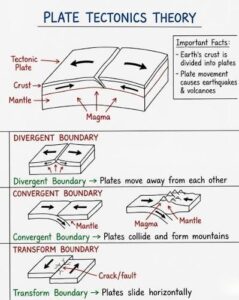
7.1 Divergent Boundary (Constructive)
- Plates move apart; magma rises and new crust
- Creates mid-ocean ridges, rift valleys, and sea-floor spreading.
- Examples: Mid-Atlantic Ridge (including the North American–Eurasian plate separation), East African Rift Valley.
7.2 Convergent Boundary (Destructive)
Plates collide; one may sink (subduction) and crust is destroyed.
| Type | What happens | Result | Examples |
| Oceanic–Oceanic | Denser oceanic plate subducts under the other | Deep trench + volcanic island arcs | Japan, Philippines, Indonesia (Mariana Trench) |
| Oceanic–Continental | Denser oceanic plate subducts under continental plate | Trench + volcanic fold mountains | Andes (Nazca under South American Plate), Rockies |
| Continental–Continental | Neither sinks easily; crust crumples | Fold mountains | Himalayas, Alps |
7.3 Transform Boundary (Conservative)
- Plates slide horizontally past each other.
- Crust is neither created nor destroyed.
- Causes frequent earthquakes.
- Example: San Andreas Fault, California (Pacific Plate and North American Plate).
Comparison
| Boundary | Movement | Crust | Features |
| Divergent | Apart | Created | Ridges, rift valleys |
| Convergent | Towards each other | Destroyed | Trenches, mountains, volcanoes |
| Transform | Sideways | Unchanged | Faults, earthquakes |
8. Plate Tectonics and Continental Evolution
- Wegener’s Continental Drift (1912): all continents once formed a single supercontinent, Pangaea.
- Sea-floor spreading and paleomagnetism later confirmed that continents ride on moving plates.
- Continents constantly collide, break apart and reshape the globe.
- India’s journey: The Indian landmass broke from Gondwanaland, drifted northwards across the Tethys Sea, and collided with Eurasia, forming the Himalayas (still rising a few mm each year).
9. Plate Tectonics and India
- India lies on the Indo-Australian Plate, which moves north and pushes against the Eurasian Plate.
- This collision makes the Himalayan region highly earthquake-prone.
- Tethys Sea sediments were folded upward to form the Himalayas.
PREVIOUS YEAR QUESTION
- Who among the following proposed the “Continental Drift Theory” in 1912, which laid the foundation for modern plate tectonics? (RRB NTPC (Graduate) 2024)
(a) Arthur Holmes
(b) Alfred Wegener
(c) Harry Hess
(d) Tuzo Wilson
Correct Answer: (b) Alfred Wegener
- What is the primary driving mechanism responsible for the movement of tectonic plates? (RRB NTPC (UG)2025)
(a) Earth’s gravitational pull
(b) Tidal force of the Moon
(c) Thermal convection currents in the mantle
(d) Ocean waves
Correct Answer: (c) Thermal convection currents in the mantle
- The formation of the Himalayan mountain range is the result of which type of plate collision? (RRB NTPC (Graduate) 2025)
(a) Oceanic–Oceanic convergence
(b) Continental–Continental convergence
(c) Divergent boundary
(d) Transform fault
Correct Answer: (b) Continental–Continental convergence
- The Mid-Atlantic Ridge is a classic example of which type of plate boundary? (RRB ALP 2026)
(a) Divergent (Constructive) boundary
(b) Convergent (Destructive) boundary
(c) Transform (Conservative) boundary
(d) Passive continental margin
Correct Answer: (a) Divergent (Constructive) boundary
- The San Andreas Fault in California represents which type of plate margin? (RRB ALP 2025)
(a) Divergent boundary
(b) Subduction zone
(c) Transform boundary
(d) Collision boundary
Correct Answer: (c) Transform boundary