Principles of Language Teaching
Introduction: Three Foundational Pillars
Effective language teaching is based on three major principles:
1. Psychological: How learners receive, process and retain language.
2. Linguistic: Language structure, sounds and usage.
3. Pedagogical: Child-centred teaching methods, materials and lesson planning.
Core Principles of Language Teaching
1. Principle of Habit Formation
- Language is a skill developed through practice, not memorisation.
- Four steps: Recognition → Imitation → Repetition → Variation.
- Develop correct pronunciation, intonation and direct thinking in the target language.
2. Principle of Motivation and Interest
- Intrinsic: Learning through personal interest and enjoyment.
- Extrinsic: Learning for marks, rewards and praise.
- Games, storytelling and audio-visual aids reduce anxiety and the Affective Filter.
3. Principle of Natural Order (LSRW)
- Natural sequence: Listening → Speaking → Reading → Writing.
- Oral skills must develop before reading and writing.
4. Principle of Oral Approach
- Speech is the foundation of communication.
- Prioritise listening and speaking before written work.
- Develop pronunciation, sound awareness and confidence.
5. Principle of Situational / Contextual Presentation
- Never teach vocabulary and grammar in isolation.
- Use real objects (Realia), pictures, role-play and dialogues.
- Connect language directly with real-life situations.
6. Principle of Proportion
- Give balanced attention to all four LSRW skills.
- Receptive skills: Listening and Reading.
- Productive skills: Speaking and Writing.
7. Principle of Learner-Centredness
- Maximise Student Talk Time (STT) and minimise Teacher Talk Time (TTT).
- Teacher acts as a facilitator.
- Encourage pair work, group work and role-play.
8. Principle of Linking with Life
- Connect language with daily life, society and culture.
- Practical learning makes language meaningful and effective.
9. Principle of Individual Differences
- Every learner has a different ability, background and learning pace.
- Use differentiated instruction, multi-sensory aids and flexible teaching.
- Provide suitable tasks for slow, average and advanced learners.
Principles of Selection and Gradation
Selection – What to Teach
Five criteria for selecting vocabulary and structures:
1. Frequency: How often a word is used.
2. Range: Number of different situations in which it is used.
3. Coverage: Number of meanings or ideas expressed by a word.
4. Availability: Ease of demonstrating a word using available objects.
5. Learnability / Suitability: Suitability for learners’ age and mental level.
Gradation – How to Sequence
Two processes:
1. Grouping: Arranging related language items together.
- Phonetic: Similar sounds – cat, bat, rat, mat.
- Lexical / Thematic: Same topic – pen, book, pencil.
- Semantic: Similar meanings – rich, wealthy, affluent.
- Grammatical: Similar sentence structures.
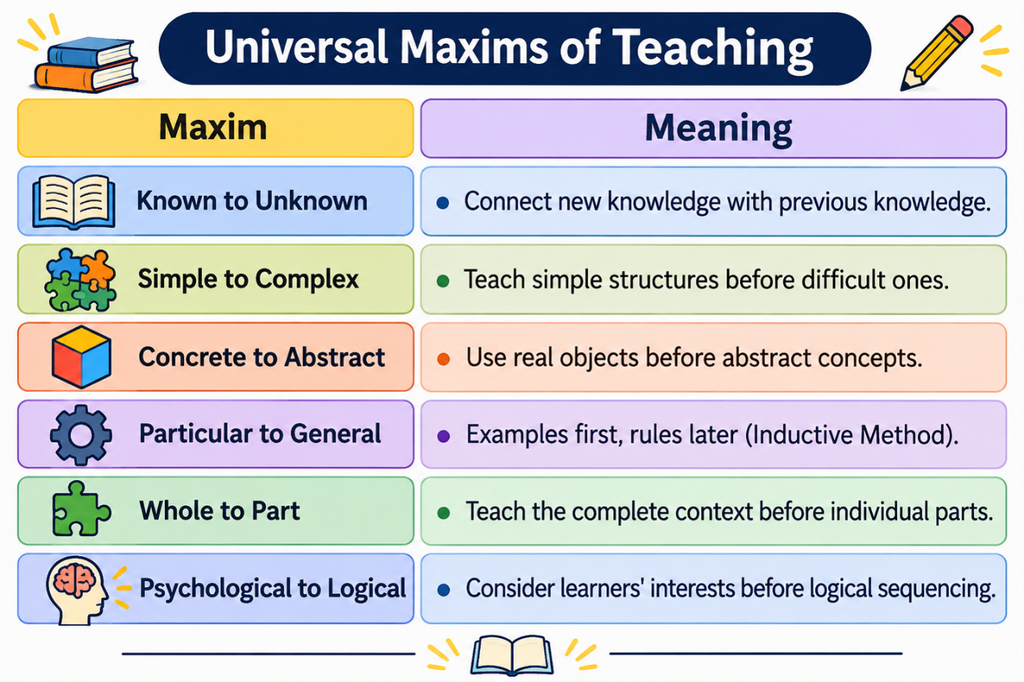
2. Sequencing: Arranging content progressively from easy to complex.